
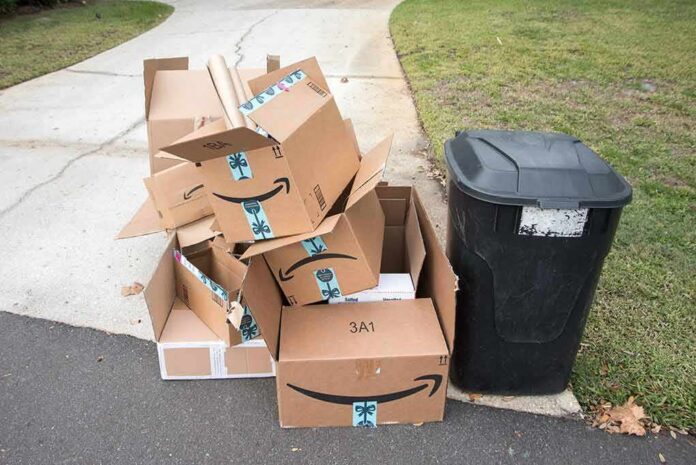
When a three-year-old is reportedly bitten by a rattlesnake hiding beneath an Amazon package in suburban Santa Clarita, the story is sensational—but it sits squarely inside a very real and steadily growing pattern: venomous snakes using our cluttered, human-built spaces as shelter, and families underestimating how close that risk now lives to their front door.
At a Glance
- Rattlesnakes, including the Southern Pacific species, are well established in urban and suburban Southern California, routinely sheltering under artificial cover such as packages, playhouses, and yard debris.
- The Santa Clarita package-bite story rests almost entirely on a single media account; while plausible, it lacks independent medical or wildlife verification and should be treated as an instructive risk scenario rather than a fully documented case.
- Verified incidents in California and Florida show rattlesnakes found inside or adjacent to delivery packages and at preschools, underscoring that “snake-in-package” and “snake-on-playground” encounters, though rare, do occur in the real world.
- For adults and children alike, the difference between a frightening close call and a medical emergency hinges on two things: recognizing typical rattlesnake habitat around the home and knowing exactly what to do—and what not to do—when a bite happens.
- Media outlets and snake-removal professionals now occupy opposite sides of the same ecosystem: one amplifies fear, the other manages risk; understanding both helps families respond with calm, informed caution rather than panic.
What We Know—and Don’t Know—About the Santa Clarita Package Bite
The starting point for this case is narrow: a single New York Post story quoting father Manuel Barajas, who says his three-year-old daughter Addy was bitten on her left side while rushing to pick up an Amazon package outdoors in Santa Clarita. According to his account, a Southern Pacific rattlesnake was concealed beneath a brown padded envelope; the child reached for the package and was struck. The report does not provide hospital records, statements from treating physicians, or confirmation from wildlife officers who might have captured or identified the snake. Nor does it reference photographs, video, or corroborating local coverage.
That does not make the account implausible—only under-documented. The setting (a preschool or residential outdoor area in Santa Clarita) fits what herpetologists describe as typical rattlesnake habitat at the urban edge, and the cited species, Crotalus helleri, is common throughout Los Angeles County’s foothills and valleys, including Santa Clarita. But from an evidentiary standpoint, this remains a single-source narrative. For a reader trying to separate fear from fact, the responsible posture is straightforward: treat the story as a credible illustration of a real risk, not as a fully verified incident, while asking what broader patterns—and practical lessons—it points to.
Rattlesnakes in Suburban Southern California: Why Packages and Playgrounds Attract Them
To understand why a rattlesnake might end up beneath a delivery envelope or inside a preschool playhouse, you have to think like the animal, not the homeowner. Southern Pacific rattlesnakes favor a mix of chaparral, dense vegetation, rock piles, and artificial cover—anything that offers shade, a sense of enclosure, and proximity to prey such as rodents. Wildlife agencies and local safety materials for California consistently note that these snakes are “found in most habitats in the region, including urban” and that they will readily use human-made clutter—boards, tarps, stacked lumber, garden equipment—as shelter.
In Santa Clarita and the surrounding valleys, public health and outreach documents describe rattlesnake season as running from roughly March through October, with encounters most frequent in warmer months and at the interface between homes and open space. Hands, feet, and ankles are the most common bite sites, because people tend to step or reach into concealed spaces—under logs, into brush, behind rocks—without visually clearing them first. An opaque padded envelope left on warm ground, in a yard or play area that already offers rodent traffic and hiding spots, is functionally just another piece of “artificial cover.” To a rattlesnake, the package is not an Amazon product; it is a shaded microhabitat.
Documented Parallels: Packages, Playhouses, and Real-World Snake Encounters
Although wildlife agencies do not track “package-origin” bites as a distinct category, there are documented incidents that mirror the structural features of the Santa Clarita story. In 2024, a man at a Mojave Desert post office opened a mailed package and found a live Western rattlesnake inside, a species closely related to the Southern Pacific rattlesnake and common in California. The package had been shipped through normal channels; the snake was discovered only when the recipient handled it. In Florida in 2023, an Amazon delivery driver was bitten by an Eastern diamondback rattlesnake near a package drop, sustaining serious injuries that required intensive hospital care. These events demonstrate that venomous snakes can and do intersect with delivery logistics in ways most customers do not anticipate.
Closer to the Santa Clarita narrative, recent coverage and social media documentation show rattlesnakes appearing in preschool environments in the Saugus area of Santa Clarita. In one case, a child spotted a rattlesnake inside a playhouse and alerted a teacher; a local removal expert—known as a “snake wrangler”—was called to safely capture and remove the animal, and no injuries occurred.[KTLA video summary] In another grassroots report, rattlesnake specialist Kerry Kish responded to CBS Preschool in Saugus after a venomous rattlesnake was discovered coiled inside a playground playhouse; he removed the snake using professional equipment, again without harm to children.[True Crime with Megan summary] These incidents are independently documented and emphasize two key points: children do sometimes encounter rattlesnakes in what adults assume are “safe” play spaces, and early recognition plus calm adult response can avert tragedy.
The Southern Pacific Rattlesnake: Behavior, Venom, and Human Risk
The Southern Pacific rattlesnake is not an exotic invader; it is the default rattlesnake of much of coastal and foothill Southern California. Field guides and herpetological references describe a heavy-bodied snake, typically brown, tan, or black with darker dorsal blotches, and a triangular head—features that can be mistaken for nonvenomous species by untrained observers. Adults commonly reach lengths around three to four feet. Behaviorally, these snakes are defensive rather than aggressive; they strike when threatened or accidentally disturbed, particularly when stepped on or reached toward at close range.
Medically, the venom of Crotalus helleri can cause significant local tissue damage, swelling, pain, and systemic effects including coagulopathy (blood-clotting disruption). Modern antivenom is effective when administered promptly, which is why California guidance repeatedly stresses that most rattlesnake bites are survivable with timely hospital care. In Los Angeles County and surrounding regions, public health materials emphasize that rattlesnake venom is “of such a nature as to usually allow ample time for successful medical treatment,” provided the victim is transported quickly and old folk remedies are avoided. The pediatric risk is serious—children have smaller body mass relative to venom dose—but the mechanism of harm and the pathway to survival are well understood.
First Response: What To Do—and Avoid—After a Bite
The difference between a frightening bite and a life-altering one often comes down to what happens in the first thirty minutes. Across expert guidance—from city fire departments to reptile safety programs—the recommended steps are consistent. Remain as calm as possible; panic accelerates heart rate and venom distribution. Immobilize the bitten extremity at or slightly below heart level, and remove constricting items such as rings, bracelets, tight shoes, or clothing before swelling makes them difficult or dangerous to remove.
Equally important are the things not to do. Do not apply a tourniquet, ice the wound, cut the skin, or attempt to suck out venom—these are all well-debunked practices that can worsen tissue damage or delay proper care. Do not attempt to kill, capture, or move the snake; no one has ever been bitten by leaving a snake alone, and additional handling exposes others to risk. The correct next step is unequivocal: call 911 and transport the victim to the nearest medical facility as quickly and safely as possible. In a setting like a preschool or home in Santa Clarita, that usually means emergency services rather than self-transport, given the risk of loss of consciousness en route.
Prevention Around Homes, Preschools, and Delivery Areas
From a prevention standpoint, the goal is not to eradicate rattlesnakes—an impossible and ecologically unwise ambition—but to reduce attractive microhabitats where humans and snakes collide. Local experts in the Santa Clarita Valley point first to “clutter management”: removing boards, stacked lumber, unused planters, and other objects that create shaded crevices where snakes and rodents can shelter. Keeping grass trimmed, brush cleared, and garbage secured reduces both the cover and the food base that draw snakes into yards.
For preschools and play areas, that logic extends to playground structures. Closed playhouses, plastic tunnels, and infrequently inspected equipment are perfect hiding spots. Institutions that have experienced rattlesnake visitors increasingly rely on regular inspections, staff training to recognize snakes, and relationships with local removal specialists—people like the Santa Clarita “snake wrangler” who can be called quickly when a child reports a sighting.[KTLA video summary] Around delivery zones, simple habits help: visually sweep the area before children are allowed to retrieve packages, avoid placing parcels in deep vegetation or beside woodpiles, and teach children not to reach blindly under or behind objects outdoors. The California Department of Fish and Wildlife’s guidance to “always look for concealed snakes before picking up rocks, sticks or firewood” extends neatly to packages and padded envelopes.
Santa Clarita. 2nd alarm brush fire at Center Pointe Pkwy and Ferry Court. #PointeFire. Preschool sheltering in place on Golden Triangle. E143 en route to assess needs and for situational awareness. pic.twitter.com/2QoBiSUTYC
— LA Fire Alerts (@LAFireAlerts) July 15, 2026
Media, Corporate Risk, and Family Reality
The Santa Clarita package-bite story surfaces at the intersection of three powerful incentives. Tabloid-style outlets benefit from fear-driven headlines—“terrifying warning,” “lurking rattlesnake”—that maximize engagement regardless of evidentiary depth. Amazon and other delivery companies, by contrast, face reputational risk if customers begin to associate packages with hidden venomous animals, even when such events are statistically rare. Meanwhile, families and preschools simply live with the day-to-day reality that in much of Southern California, rattlesnakes are part of the local fauna and sometimes enter their spaces.
In that mix, the healthiest stance is neither dismissive skepticism nor uncritical panic. The father’s account of a rattlesnake under an Amazon envelope may never be fully documented in public records, yet there is ample independent evidence that similar configurations—snakes using packages and playground structures as shelter—are real and recurring, if uncommon. For a reader trying to safeguard children, the takeaway is pragmatic: assume rattlesnakes are present in season, design yards and play areas to minimize hiding spots, respond to bites with modern medical protocol, and treat sensational stories not as the whole truth, but as rough case studies pointing to real-world behaviors. The snakes are not new; only the way we tempt them into our daily routines is.
Sources:
nypost.com, theguardian.com, abcnews.go.com, cbsnews.com, kiro7.com, weartv.com, youtube.com, thesnakeschool.com, hometownstation.com, wildlife.ca.gov