
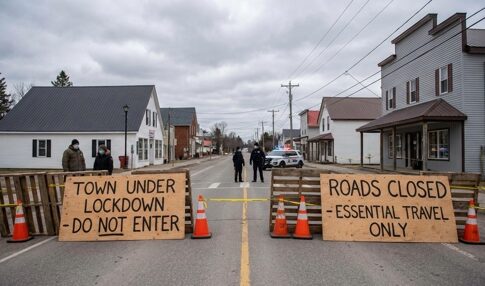
When a U.S. city orders 100,000 people indoors over a soccer game, it shows how fragile public safety — and civil liberty — have become.
Story Snapshot
- Brockton, Massachusetts has ordered a citywide 10 p.m.–5 a.m. curfew tied to Cape Verde’s World Cup match against Argentina.
- City officials cite nine shootings, two stabbings, and 75 arrests across recent World Cup celebrations as the reason for the crackdown.
- The curfew sharply limits nightlife and movement, raising hard questions about government power, personal freedom, and equal treatment.
- The move fits a growing national pattern of using broad emergency rules instead of fixing deeper crime and trust problems.
What Brockton Officials Are Doing, And Why It Matters
City leaders in Brockton, a working-class suburb south of Boston, have announced a temporary citywide curfew from 10 p.m. Friday to 5 a.m. Saturday, timed to Cape Verde’s high-stakes World Cup match against Argentina. Mayor Moises Rodrigues says the order is meant “to protect public safety” after post-game celebrations turned violent during the last three matches, including four shootings after the most recent game. Bars that serve alcohol must stop new entry at 7 p.m., with last call at 9:30 p.m.
Officials say they are acting under a Massachusetts law that allows cities to declare temporary safety curfews. Brockton has also asked for National Guard support, signaling they expect large crowds and serious risk. The city is home to one of the nation’s largest Cape Verdean communities, nearly 20,000 people, and is often called the “11th island” of Cape Verde. That pride has fueled huge street celebrations, but those events have now become linked to gunfire, stabbings, and dozens of arrests.
How The Curfew Works On The Ground
The curfew requires most residents to stay inside their homes or private property between 10 p.m. and 5 a.m. The mayor’s proclamation lists exceptions, including police, firefighters, emergency medical workers, people traveling to or from work, and those seeking emergency medical care or acting under official government orders. Brockton police are directed to enforce the rules “in accordance with all applicable state and federal laws,” turning routine Friday night activity into a matter of law enforcement discretion.
For local businesses, especially bars and restaurants, the rules bite hard. No new customers can enter alcohol-serving venues after 7 p.m., and all alcohol sales must stop by 9:30 p.m. That timing hits the heart of weekend traffic, including World Cup watch parties and the July 4 holiday crowd. Some owners warn that lost revenue and confused customers could deepen the sense that government solves problems by punishing small business, not by tackling gangs, illegal guns, or weak prosecution. Residents already skeptical of “elite” decision makers may see this as one more top-down order.
Safety, Freedom, And A Divided Public
The mayor points to a stark record: nine shootings, two stabbings, and 75 arrests across the last three Cape Verde World Cup games in Brockton. Those numbers, if accurate, describe a serious breakdown in basic order and justify strong concern about people caught in the crossfire. National law enforcement guidance around major sporting events, including from the United Nations, does call for layered security plans and firm rules to prevent violence and chaos. In that sense, Brockton’s move follows a broader trend of treating big games as security operations, not just parties.
Yet history shows curfews can come with a heavy social cost. Researchers who have studied pandemic-era curfews found they can spark anger and push people to gather earlier in the day instead of staying home altogether. Civil liberties scholars note that curfews have often targeted minority or youth communities and can carry a “dark history” of unequal enforcement. In Brockton, a largely Cape Verdean celebration is now linked to a citywide lockdown, raising quiet worries that a proud immigrant community is being treated as a public safety problem rather than a partner in solutions.
A Local Flashpoint In A National Pattern
Across the country, cities have turned to night curfews during protests, pandemics, and bursts of youth violence, sometimes after specific shootings, sometimes as a broad preventive tool. These measures often arrive quickly, without much public debate, and are justified as “temporary” steps to keep order. Brockton’s curfew fits that mold: an emergency response that targets the hours, not the causes, of violence. At the same time, national planning for the 2026 World Cup has stressed that existing laws on public drinking, weapons, and disorder will be enforced, not replaced, at stadiums and fan zones. That raises a hard question: when does enforcement of existing laws stop being enough?
Brockton, Massachusetts, home to one of the largest Cape Verdean communities in the U.S., has imposed a temporary curfew ahead of Cape Verde’s World Cup match after recent celebrations were marred by violence, officials say. #OnTheGriohttps://t.co/3JaJGA6VbL
— theGrio.com (@theGrio) July 3, 2026
For many Americans on both the left and right, this moment in Brockton touches a deeper frustration. People see rising crime, strained police, and slow courts. They also see leaders who answer with curfews, emergency orders, and National Guard call-ups, but rarely with long-term fixes like better local policing, faster justice, and stronger community ties. Supporters of the curfew say Brockton cannot risk more shootings. Critics worry that once city leaders learn they can shut down whole neighborhoods by proclamation, that power will be used again — for the next crisis, the next protest, or the next event the “deep state” decides is too risky for ordinary freedom.
Sources:
foxnews.com, wbur.org, youtube.com, facebook.com, ojjdp.ojp.gov, instagram.com, un.org, kcl.ac.uk, citymayors.com
This isn’t America. This is not freedom. They have a problem and taking away everyone’s freedom is not the solution.
If I lived in Brockton, I’d be glad for the lockdown. It shows the powers that be are trying to keep us safe.