

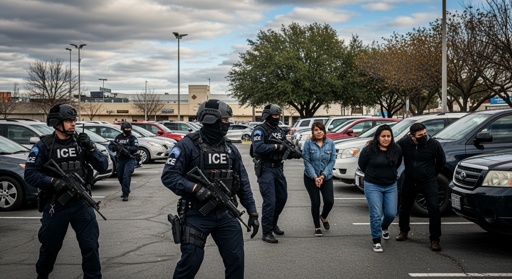
A new Trump policy drive is moving to strip citizenship from fraudsters while globalists howl that basic law enforcement is somehow a threat to America itself.
Story Snapshot
- The Justice Department plans at least 250 denaturalization cases this year, a huge jump from past decades.
- A 2025 memo orders lawyers to “prioritize and maximally pursue” revoking citizenship obtained by fraud or lies.
- Critics warn of fear and “weaponization,” but Supreme Court rulings and federal law tightly limit who can be stripped of citizenship.
- Trump’s team frames the push as defending honest immigrants, national security, and the rule of law.
Trump’s Citizenship Crackdown: What Is Really Changing?
The Trump administration is no longer treating denaturalization as a rare, symbolic tool; it is turning it into a real enforcement arm aimed at people who lied or hid serious crimes to become citizens. Between 1990 and 2017, the federal government brought only about eleven denaturalization cases per year, which meant fraudsters could gamble that they would never be caught.[14] Now the Justice Department expects to file at least 250 cases by the end of fiscal year 2026, a massive shift in pace and priorities.[1]
The Department of Justice’s Civil Division put that shift in writing in a June 11, 2025 memo. That document tells government lawyers to “prioritize and maximally pursue denaturalization proceedings in all cases permitted by law and supported by the evidence,” and lists categories such as national security threats, gang activity, war crimes, human trafficking, and major financial fraud.[8][20] In simple terms, if someone gamed the system and poses a risk, Trump’s team wants their case on the front burner.
The Law: Strong Tools, Tough Limits
Federal immigration law has long allowed denaturalization when citizenship was “illegally procured” or obtained by hiding a material fact or willful misrepresentation, under title 8, section 1451 of United States law.[8] That power is not new; what is new is that it is finally being used at scale after decades when almost no one lost citizenship for fraud. Courts, however, insist on a very high bar: the government must prove its case with “clear, convincing, and unequivocal evidence” that leaves no real doubt.[14]
The Supreme Court has also drawn bright lines that should reassure honest immigrants. In 1967, the Court held that the government cannot take away citizenship against someone’s will unless it was unlawfully obtained in the first place.[11] In 2017, the Court ruled that even a lie is not enough by itself; the false statement must have a direct link to the person receiving citizenship.[11] These rulings mean denaturalization cannot be used as a simple political weapon against people the administration dislikes, no matter what activist groups claim.
How Big Is the New Push, and Who Is Targeted?
For years, denaturalization averaged only about a dozen cases annually, which critics and supporters agree is extremely rare for a country with more than 24 million naturalized citizens.[14][21] Under Trump’s second term, that trickle has turned into a steady stream. Internal figures and outside tracking show dozens of new cases in recent months, with filings in May and June 2026 alone far above historic levels.[4] A Justice Department official told reporters that the goal is at least 250 cases in this fiscal year, a level not seen in modern times.[1][9]
Despite heated rhetoric, the early case record looks focused on serious wrongdoing, not simple paperwork errors. An investigation of 34 publicly known denaturalization cases handled so far found they mostly involved child sexual abuse, terrorism-related activities, war crimes, drug trafficking, and large-scale fraud, with allegations that defendants hid these facts during the naturalization process.[6] The administration has also highlighted targets with suspected ties to gangs, cartels, and organized financial scams, especially when those crimes exploited Americans or national programs.[7][20]
Critics Warn of Fear and “Weaponization” – Are They Right?
Left-leaning legal groups and immigration activists argue that this expansion sends a chilling message to all naturalized citizens, even those who followed the rules.[3][23] They point to the open-ended language in the 2025 memo that allows the Civil Division to pursue “any other cases” it deems important, and warn that future administrations could stretch that clause to punish political speech or minor infractions.[3][23] For communities already wary of Washington, the idea that citizenship might feel less permanent is deeply unsettling.
On X Today:
Trump admin ramps up effort to revoke citizenship obtained through fraud written by Dillon Burroughs June 19, 2026.
GROK will this include Ilhan Omar who "married her brother" according to some sources, to get legal citizenship in the United States?
Please clarify… pic.twitter.com/wEvkplMMAZ— BarryMoore (@BarryMoore70635) June 20, 2026
At the same time, the legal safeguards those critics cite cut hard against their own worst-case scenarios. The Brennan Center, which is no friend of the Trump White House, stresses that any attempt to turn denaturalization into a political “weapon” faces “significant legal hurdles” because of firm Supreme Court limits rooted in the First and Fourteenth Amendments.[11] In practice, every case must go through a federal judge, under a heavy burden of proof, with no shortcut for any agency or politician.[16][20] That structure makes broad, arbitrary citizenship sweeps extremely unlikely.
Why Many Conservatives Back the Crackdown
For many constitutional conservatives, the key question is simple: Should citizenship obtained through lies or hidden felonies be treated the same as citizenship earned honestly? The Trump administration’s answer is no, and it is acting on that answer using laws already on the books.[8][14] Supporters see this as basic fairness to millions of immigrants who waited in line, paid fees, passed background checks, and took the oath in good faith, only to see cheaters enjoy the same benefits.
There is also a clear security and sovereignty angle. When people with terrorism ties, gang leadership roles, or serious financial crimes manage to pass as “good moral character” and gain citizenship, they gain powerful protections against removal and can more easily hide in plain sight.[6][20] Tightening denaturalization in these cases fits with Trump’s broader effort to crack down on illegal immigration, end birthright citizenship abuse, and roll back the loose, globalist approach that helped fuel crime, welfare fraud, and distrust in the system.[1][5][22] For readers worried about border chaos and two-tier justice, this campaign looks less like an “attack on immigrants” and more like finally enforcing the rules that protect both citizens and honest newcomers.
Sources:
[1] YouTube – Trump Administration Unveils Major Policy Push From Immigration to …
[3] Web – Scoop: Trump escalates citizenship crackdown – Axios
[4] Web – The Denaturalization of U.S. Citizens – Democracy Forward
[5] Web – Denaturalization Lawsuits Jump in May and June 2026
[6] Web – The Trump administration on Friday announced a major … – Instagram
[7] Web – Stripping U.S. citizenship for some is harder than Trump vowed – NPR
[8] YouTube – Trump Moves to Denaturalize Citizens, End Birthright …
[9] Web – [PDF] CIV Enforcement Memo – Department of Justice
[11] Web – Featured Issue: Threats to Citizenship and Naturalization
[14] Web – Denaturalization: What You Need to Know – Asian Law Caucus
[16] Web – Featured Issue: Threats to Citizenship and Naturalization
[20] Web – [PDF] Denaturalization and the Negative Effects of Widespread …
[21] Web – FAQs: How Denaturalization Works | ILRC
[22] Web – Denaturalization was used in only about a dozen cases a year …
[23] Web – Stripping Naturalized Americans of Citizenship Faces High Legal …