
The gun most schools barely mention may have done more to win American independence than the legendary frontier rifle.
Story Snapshot
- The simple smoothbore musket, not the long rifle, was the main battlefield weapon of the Revolution.[3]
- The Brown Bess musket became the most common firearm in American hands, despite being a British design.[7]
- Rifles were deadly at long range, but slow reloads and no bayonets made them risky in close combat.[3]
- Modern media and museums still push a romantic “rifleman legend,” hiding how massed muskets really fought the war.[6]
The Musket: Workhorse of the American Revolution
On Revolutionary War battlefields, the smoothbore flintlock musket was the main weapon used by both sides.[3] Armies fielded long lines of soldiers with nearly identical guns, built for speed more than accuracy. A typical musket was about five feet long, weighed close to ten pounds, and fired a large lead ball down a smooth barrel.[3] That design kept costs low and production simple, which mattered for a new nation scrambling to arm thousands of men.
Effective range for these muskets was short, usually under eighty to one hundred yards.[3] Shots beyond that distance became unreliable, so commanders relied on tight formations and mass volley fire to make up for poor aim.[3] A well-trained soldier could fire three or four shots a minute, reloading while standing in the open under enemy fire.[3] This mix of speed, simplicity, and brutal close-range power is why one historian’s film flatly concludes that “independence was won by the cheap and simple smoothbore musket.”[10]
Brown Bess and Charleville: The Guns Both Armies Shared
The British Land Pattern “Brown Bess” musket was the standard infantry weapon of the British Army and quickly became common in American ranks too.[2] Colonists seized British muskets from storehouses, captured them in battle, and used them alongside French Charleville muskets supplied by America’s wartime ally.[7] These shared designs meant American and British line infantry often faced each other with nearly identical weapons, turning tactics and leadership into the real edge.[1]
The Brown Bess musket could fire three to four shots per minute in trained hands.[2] The Charleville musket was similar in size and weight but had a reputation for slightly better accuracy.[2] Battlefield guides today still stress that smoothbore muskets like the Brown Bess and Charleville were the most prevalent firearms of the war, while rifles and pistols appeared in smaller numbers.[4] That picture clashes with many school lessons and TV shows, which tend to focus on a lone rifleman picking off redcoats from a distant hill.[4]
Rifles: Accurate, Deadly, and Dangerous to Use Wrong
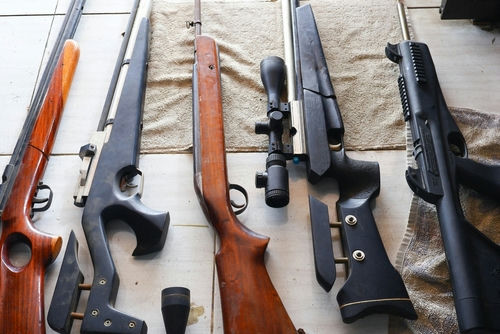
American long rifles, often made in frontier towns, were famed for accurate shooting at about three hundred yards.[3] This accuracy came from grooves in the barrel that spun the bullet, giving it a stable flight. Many riflemen were hunters used to hitting small targets at long range, and they could punish British units that marched in rigid lines. In rural warfare and hit-and-run skirmishes, rifles gave patriots a real edge.[4]
Those same rifles were slower to reload and usually could not mount bayonets, the blades fixed to muskets for hand-to-hand fighting.[3] On crowded battlefields, riflemen without bayonets were exposed if enemy troops closed the distance. Modern historians note that rifle units worked best when supporting musket-armed infantry, not acting alone.[6] Rifles were tools for special jobs—ambushes, sniping officers, guarding rough ground—but they were not the standard weapon that carried most of the war’s heavy fighting.[6]
Myth-Making, Elites, and Why the Rifleman Legend Won
Historians and battlefield educators agree that smoothbore muskets were the main weapon of the Revolution, yet popular culture still lifts up the long rifle as the symbol of freedom.[3] Museums and heritage groups like the American Revolution Institute often highlight elegant Pennsylvania long rifles in their displays and stories.[7] TV series and school textbooks repeat the image of the lone rifleman outsmarting the British, because it makes for a cleaner, more heroic story than masses of soldiers firing crude muskets in smoky lines.[4]
During the Revolutionary War as British forces closed in on Philadelphia in 1777, Patriots feared the iconic Liberty Bell would be seized and melted down into ammunition for enemy cannons and muskets.
So the Patriots took action. The massive 2,000 pound Liberty Bell was… pic.twitter.com/XcDJZAujN3
— HeritageBulwark (@hbulwark1) June 27, 2026
This gap between research and myth fits a wider pattern in American history, where romantic tales beat hard facts three to five times more often in classrooms and media.[4] Today, when many Americans distrust federal leaders and the so-called “deep state,” this old rifleman legend shows how elites shape our view of the past too. By selling a neat story instead of a messy truth about massed musket fire, they hide how ordinary, poorly equipped men—with simple, cheap guns—actually fought and bled to secure the liberty we are still arguing over now.[4]
Sources:
[1] Web – The Gun That Won the Revolution
[2] Web – Revolutionary War Weapons: The Brown Bess Musket
[3] Web – Small Arms of the Revolution | American Battlefield Trust
[4] Web – List of infantry weapons in the American Revolution – Wikipedia
[6] Web – Muskets and Rifles of the American Revolution – Reddit
[7] Web – The Myth of the Rifle During the American Revolution – Osprey
[10] YouTube – How Revolutionary War Muskets Were Used in Battle