
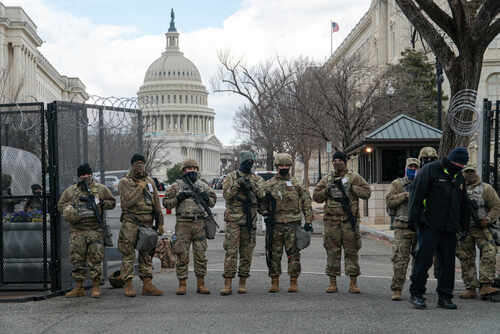
The real story is not simply that National Guard troops in Washington will stay through the end of Trump’s term; it is that an extraordinary domestic military presence has been normalized on a theory of public safety that the available evidence has not decisively validated. The extension may be politically durable and legally plausible in the narrow sense of D.C.’s unusual status, but the justification rests on contested crime claims and a federal power grab that courts and analysts have already begun to scrutinize.
Key Points
- The Pentagon has confirmed that the D.C. deployment is now set to last through Inauguration Day 2029, unless the president ends it earlier.
- Trump’s original rationale was a declared “crime emergency,” even though violent crime in the city was already at a 30-year low when the mission began.
- Independent analyses found little to no effect on violent crime, undercutting the administration’s core claim that the Guard is driving the public-safety gains.
- The deployment has become a test case for how far the federal government can go in using troops for domestic policing in the nation’s capital.
The legal and political significance of the 2029 extension
The extension matters because it turns what was framed as a temporary emergency response into a near full-term security architecture for the capital. According to the Pentagon, the Guard will remain deployed in Washington through January 20, 2029, or until the president terminates the mission. That places the operation squarely within Trump’s second term and makes it the longest domestic military deployment for law-enforcement purposes in U.S. history, a distinction that is not merely symbolic; it changes the baseline for what later presidents may treat as normal.
D.C. is legally unusual. Unlike a state, it does not have a governor who can resist federal activation of the local Guard in the same way state executives have challenged deployments elsewhere. That is why the administration has been able to press a much more aggressive posture here than it likely could in most other jurisdictions. Still, unusual authority is not the same thing as sound policy, and the fact that the president can do something does not answer whether the thing is effective, proportionate, or wise.
What the administration says the deployment is for
The White House’s public case has been straightforward: the Guard is part of an anti-crime mission meant to restore law and order in a city the president has repeatedly described as dangerous and out of control. The original deployment followed Trump’s executive order declaring a crime emergency in August 2025, and defense officials have since described the mission in terms of continuing presidential initiatives to restore order. In the administration’s telling, the Guard is not merely present; it is a visible instrument of deterrence, reassurance, and federal control.
That argument depends on a simple causal story: put uniformed personnel in the streets, reduce disorder, reduce crime, and stabilize public life. It is an intuitively appealing story, which is why it recurs so often in American politics. But intuition is a poor substitute for attribution. When the claim is tested against data, the picture is far less dramatic than the rhetoric suggests.
What the evidence says about crime and effectiveness
The strongest counter-evidence is not speculative. A Niskanen Center analysis reported that the deployment produced a reduction in opportunistic property crime but no measurable effect on violent crime, and it concluded that crime had already been trending downward before the Guard arrived. That distinction is crucial. If violent crime was falling before the troops appeared, then the administration’s emergency framing loses much of its force; the Guard may have been deployed into a declining trend and then credited with a broader improvement it did not cause.
This is where the public debate often gets muddled. Supporters cite the presence of troops, headlines about arrests, and a general sense of order. Critics point to category-specific data showing that the measurable gains were narrow and concentrated, not the sweeping turnaround implied by the rhetoric. Those are not equivalent claims. A marginal effect on property offenses in public spaces is not the same thing as a decisive reduction in violent crime, and the distinction matters because violent crime was the stated emergency justifying the deployment in the first place.
The location of the patrols also matters. The Niskanen analysis concluded that effects were concentrated in opportunistic property offenses in public spaces, consistent with troops being posted around federal buildings and tourist corridors rather than embedded in the city’s higher-crime neighborhoods. That is an important operational clue. It suggests the deployment is optimized for visible federal presence, not for the kind of neighborhood-level crime suppression that would be expected if the goal were to target the city’s worst hot spots.
National Guard deployment to DC will last through Trump’s term: https://t.co/7DxBfUwz6Y
— Daily Press (@Daily_Press) July 17, 2026
The constitutional and operational friction underneath the mission
There is also a serious legal and institutional tension beneath the public relations layer. D.C. Guard members have been used in ways that resemble law-enforcement support: enforcing juvenile curfews, detaining people until police arrive, and assisting with public-order tasks, while not themselves making arrests. That split is precisely where constitutional unease begins. The American system is built to separate military force from ordinary policing, and a prolonged deployment that blurs that boundary invites challenges even when it is formally wrapped in executive authority.
The courts have already signaled discomfort with similar federalized troop deployments in other contexts, and a federal judge in D.C. ruled that Trump had overstepped by using the Guard for non-military crime-prevention missions without a request from local civil authorities. That ruling was later halted on appeal, which means the mission can continue for now, but the legal question has not disappeared. It has merely moved into a slower, more technical phase, where the exact scope of presidential power over the District will be tested against statutory limits and constitutional principle.
Why the deployment is likely to remain controversial even if it continues
Even if the Guard stays in place through 2029, the political controversy is not going away, because the deployment has two vulnerabilities that reinforce each other. First, the public-safety case is weaker than the administration says it is; second, the institutional case is broader than many supporters admit. The first problem is empirical, the second constitutional. Together they make the mission vulnerable to the charge that it is a costly display of force dressed up as a crime strategy.
That cost is not trivial. A Senate Homeland Security report estimated the deployment would cost hundreds of millions of dollars in its early phases, and related reporting has put the long-run expense at billions if the mission persists. That kind of outlay would be controversial even if the results were clear. When the results are mixed, the cost becomes harder to justify. The political logic of “law and order” can sustain a deployment for a long time; the policy logic is much less forgiving.
What makes the D.C. case especially consequential is that it functions as a template. The administration has already used similar arguments in other cities, often over local objections, turning the Guard into a recurring tool of domestic governance rather than an exceptional response to a true emergency. If Washington becomes the durable model, the question for the next administration will not be whether such deployments are possible. It will be whether they have become too easy to invoke, too hard to unwind, and too detached from the crime problems they are supposed to solve.
The extension to 2029 therefore signals more than persistence. It marks the consolidation of a new federal habit: treating military presence as an answer to civilian disorder, even when the underlying evidence shows only limited results and the legal footing remains contested. That is the central fact to watch, because it tells you what kind of precedent is being set long before the final troop count comes down.
Sources:
npr.org, nbcpalmsprings.com, usatoday.com, abcnews.com, thehill.com, ms.now, cnn.com, en.wikipedia.org, hsgac.senate.gov