
When a prominent propagandist publicly walks back her own talking points, the episode is more than a personal drama; it is a case study in how disinformation shapes political identity—and what it takes to break out of its grip.
Key Points
- Laura Loomer spent years denouncing Ukraine as “full of Nazi apologists” and opposing U.S. aid, echoing core Kremlin narratives about the war.
- After a frontline visit to Kyiv—including an air raid and a tour of Bucha—she issued an explicit apology and said she had been “propagandized by Russian media.”
- Loomer met and interviewed President Volodymyr Zelenskyy in Kyiv, framing the encounter as part of her effort to correct the record for a largely pro-Trump audience.
- The episode illustrates a broader pattern: high-visibility figures reverse course after direct exposure to war or evidence, raising questions about how durable such about-faces really are.
From “Nazi Apologists” to Public Apology: What Changed
For several years, Laura Loomer—an American far-right activist and vocal ally of President Trump—was a reliable amplifier of Russian talking points about Ukraine. In social media posts and commentary, she depicted Ukraine as “a country full of Nazi apologists,” accused the U.S. government of “funding Nazi death squads,” and cast President Volodymyr Zelenskyy as a “jihadi apologist.” This rhetoric closely tracked Moscow’s justification for its full-scale invasion launched in February 2022, which leaned heavily on the claim that Ukraine needed to be “de-Nazified.”
In mid-2026, Loomer did something unusual in a highly polarized information environment: she went to Kyiv on what she called a “fact-finding tour,” and then publicly acknowledged she had been wrong. After arriving in Ukraine, experiencing an air-raid alert, and visiting Bucha—one of the sites of documented Russian atrocities—she used X (formerly Twitter) to tell her followers that she had believed distorted narratives and “propaganda” rather than reality.
Her posts were not vague regrets. Loomer explicitly linked her prior statements to Russian disinformation, writing that she had been “living in a media echo chamber” and “propagandized by Russian media on social media to believe those things.” She said she would not delete her old posts, but instead wanted them to stand alongside her admission of error—a deliberate contrast meant to highlight how starkly her views had shifted.
The Kyiv Visit: Air Raid, Bucha, and a Palace Interview
Loomer’s reversal was anchored in direct exposure to the war. During her time in Kyiv, she was caught in an air raid alarm and went to a shelter as Russian missiles targeted the capital. In one widely quoted post she wrote: “Just experienced my first air raid in Ukraine. Sirens blaring. This is everyday for every Ukrainian. I feel like such an a**hole for minimizing the struggle of Ukrainians for the last 5 years. I often said I don’t care. Looking back, that wasn’t very nice of me to say.”
She also traveled to Bucha, where documented evidence of Russian war crimes—executions of civilians, torture, and mass graves—has been central to international reporting on the invasion. Loomer described seeing photographic evidence of mutilation, including images of Ukrainians with swastikas carved into their skin by Russian forces, and used those experiences to flip her earlier framing: “Who are the Nazis? I was lied to for years,” she told one interviewer.
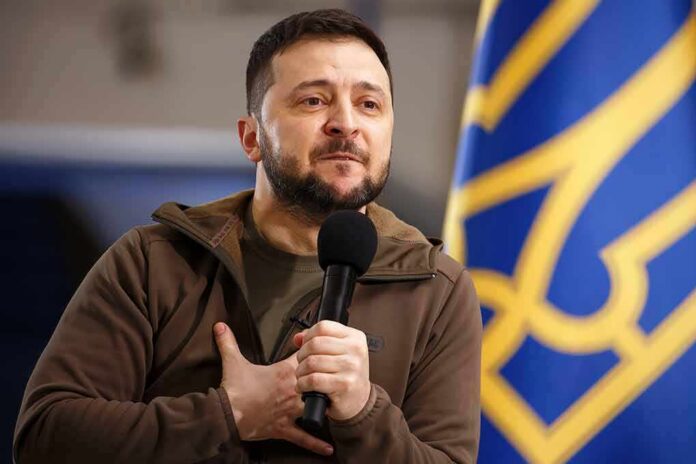
The most visible moment of the trip came when she sat down with President Zelenskyy at the Mariinsky Palace in Kyiv. The interview, described as unscripted, brought together a leader who has become the face of Ukrainian resistance and a media figure whose audience is steeped in American right-wing grievance narratives. In the conversation, Loomer acknowledged on camera that she had opposed aid to Ukraine because she believed it was “a country full of Nazis” and said she had since realized that belief was shaped by Russian propaganda.
Zelenskyy, for his part, used the interview to push back against the Nazi narrative directly, insisting there are no Nazi-led structures in Ukraine and casting the Russian aggression as a straightforward case of a larger power attacking a neighbor. Ukrainian officials later framed Loomer’s visit as “further evidence that witnessing the reality helps people break free from the influence of Russian propaganda.”
How Russian Propaganda Shaped Loomer’s Earlier Views
Loomer’s own account of her shift sheds light on how disinformation campaigns work, particularly in the fragmented social media ecosystem. After being banned from several major platforms in the wake of the 2020 U.S. election, she gravitated toward alternative outlets—including RT, the Russian state-backed media network—and Telegram channels that catered to audiences skeptical of mainstream U.S. institutions.
She has since said she wrote several articles for RT and consumed large volumes of content that portrayed Ukraine as inherently corrupt, Nazi-infested, and hostile to conservative values. Over time, those narratives fused with domestic political grievances: anger over Trump’s first impeachment—which centered on a phone call with Zelenskyy—and resentment that Washington was sending billions to Ukraine while American social and economic problems remained unresolved.
In that environment, describing Ukraine as “full of Nazi apologists” served multiple functions. It morally delegitimized Ukrainian defense needs, cast U.S. aid as support for evil, and provided a convenient frame for dismissing Russian atrocities as either exaggerated or deserved. It also aligned Loomer with a cluster of American voices—some explicitly pro-Kremlin, others simply contrarian—who argued that supporting Ukraine meant siding with globalist elites against ordinary Americans.
Her admission that she had been “bamboozled” by Russian propaganda is therefore not just a personal confession; it is a tacit acknowledgment of the machinery that turned a fringe narrative into a significant faction within American politics.
The U-Turn: Apology, Responsibility, and Skepticism
After her Kyiv trip, Loomer’s messaging changed sharply. She expressed support for Ukraine’s war effort, pledged to correct the record for her followers, and framed her new stance as a matter of “moral clarity.” In interviews and posts, she said she felt a responsibility to undo the harm of her previous rhetoric, particularly the way it minimized Ukrainian suffering and legitimized Russian aggression.
She also began talking about Ukraine not just in moral terms but in strategic ones—emphasizing, for example, Ukraine’s rapidly expanding drone production and arguing that American national security interests are tied to Ukrainian resilience in the face of Russian attacks. This reframing is aimed squarely at a U.S. audience that is wary of foreign entanglements but responsive to arguments about military technology, borders, and hard power.
Inevitably, the reversal has sparked skepticism. Some critics question whether Loomer’s change of heart is durable or whether it reflects a reputational pivot after being confronted with images that play poorly in the American mainstream. Others note that disinformation campaigns often seek to co-opt critics by bringing them into the fold, and wonder whether her palace access was part of a Ukrainian strategy to reach Trump-aligned voters rather than a purely organic reconciliation.
The available evidence, however, does not support the idea that Loomer is quietly carrying on her old line under a new veneer. Her posts and on-camera statements are clear, self-incriminating, and directly tied to the propaganda she once spread; she names RT, Russian Telegram channels, and specific narratives as influences she now rejects. That kind of detailed repudiation is qualitatively different from a vague “if anyone was offended” apology.
A Broader Pattern: Disinformation, Identity, and Firsthand Contact
Loomer’s story fits a broader pattern seen across conflicts and crises: a public figure builds an identity around a set of maximalist claims, then recants after direct exposure to facts on the ground. In the context of the Russia–Ukraine war, this pattern has particular stakes because information is itself a battlefield—Russia invests heavily in shaping Western narratives about Nazism, corruption, and fatigue with aid.
When someone with a large following acknowledges that they were wrong because they believed propaganda, that admission becomes evidence in two directions. Supporters of Ukraine cite it as proof that the “Nazi country” narrative was disinformation all along and that firsthand experience can puncture it. Skeptics point to it as an example of how easily public figures can swing from one extreme to another, and therefore treat the new stance as potentially opportunistic.
For readers trying to make sense of such reversals, the most useful distinction is between rhetorical repositioning and epistemic change—the difference between saying “the optics have shifted” and saying “my understanding of reality was wrong.” Loomer has explicitly chosen the latter language. She did not merely say she was insensitive; she said she believed falsehoods, identified their sources, and described the process by which she came to see them as lies.
That does not guarantee that every subsequent statement she makes about Ukraine will be accurate or balanced. But it does mean that, in this specific case, her earlier characterization of the country as “full of Nazi apologists” cannot be treated as a stable belief. By her own account, it was a product of an information war she now recognizes herself as having lost.
What This Episode Tells Us Going Forward
Loomer’s pivot will not, by itself, transform American public opinion on Ukraine. Yet it matters for at least three reasons.
First, it demonstrates that deeply embedded disinformation can be dislodged, but often only through costly, firsthand experiences—air raid sirens, shelter doors, and mass grave photographs. Abstract argument on social media rarely has the same effect. Second, it shows how disinformation exploits existing fractures: bans, platform migrations, and domestic grievances created a context in which Russian narratives could present themselves as the only “uncensored truth.”
Third, it illustrates the double-edged nature of public apologies in an information war. A figure like Loomer may now be able to reach audiences that Ukrainian officials cannot, precisely because her credibility in those circles was built while she was spreading the very propaganda she now condemns. Whether that access turns into durable belief change is an open question—but the fact that Kyiv is willing to have her sit down with its president suggests Ukrainian authorities believe the experiment is worth running.
For observers, the key is not to romanticize her conversion or write off her past commentary as harmless. It is to see the episode as evidence: evidence of how persuasive Russian propaganda can be when it piggybacks on domestic resentments, and evidence that even its loudest amplifiers sometimes change course when forced to look directly at the consequences.
Laura Loomer: "Who's the best president of the United States?"
🗣️ Zelensky: "Lincoln."
👀 Loomer: "President Trump is going to watch this interview."
🗣️ Zelensky: "Trump is a good, strong leader. Whether he's the best… history will answer." pic.twitter.com/fFrJ60LEBe
— Kirikaar (@Kirikaar77) July 24, 2026
Why This Matters Beyond Ukraine
Finally, Loomer’s journey is a reminder that information integrity is not an abstract concern reserved for experts and regulators. It is deeply entwined with moral judgment. For five years, she minimized the suffering of Ukrainians and helped normalize a narrative that blurred the line between aggressor and victim. After one week in a war zone, she described feeling “like such an a**hole” and spoke of the need for “moral clarity.”
That phrase is as good a lens as any. Moral clarity in an age of disinformation does not mean never being wrong; it means being willing to say, in public, that you were wrong—and to trace that error back to the machinery that produced it. In that sense, whatever one thinks of Laura Loomer’s politics, her Kyiv apology is more than a personal confession. It is a visible crack in the façade of a propaganda ecosystem that depends on certainty, never reconsideration.
Sources:
19fortyfive.com, thehill.com, upday.com, economictimes.indiatimes.com, youtube.com, nypost.com, newsukraine.rbc.ua