
When a 12-year-old boy is fatally struck by a bullet outside a neighborhood bodega while doing nothing more dangerous than standing over his bike, the incident exposes not just one tragedy, but the entire architecture of urban gun violence that turns ordinary commercial corners into lethal spaces for children.
Key Points
- A 12-year-old, identified by multiple outlets as Jacob Freytes/Freytas, was killed in a triple shooting outside a Mount Eden bodega after a fight among adult men escalated into gunfire.
- Surveillance video shows Jacob next to his bike as the fight erupts, then running into the bodega clutching his shoulder or chest before collapsing; he was pronounced dead at Lincoln Hospital.
- Two adult men, ages 25 and 34, were also shot and are reported in stable condition, underscoring that this was a broader street altercation rather than a targeted attack on the child.
- No suspect has been arrested or publicly identified, and key investigative details—ballistics, formal intent, and full chronology—remain in police control, leaving the public narrative driven largely by early media framing.
What Happened Outside the Bronx Bodega
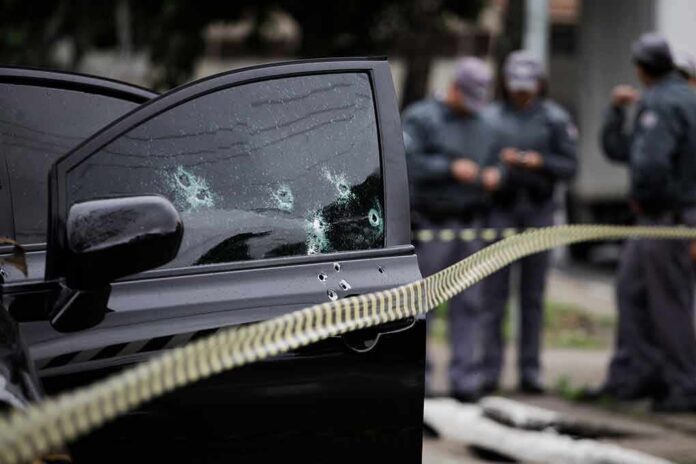
The core facts of the Mount Eden shooting are unusually consistent across outlets, which is rare in the first 24–48 hours of any major crime story. According to News 12, CBS New York, and the New York Post, police responded to a 911 call reporting three males shot outside Wanda Deli Grocery at 104 Elliot Place, a corner bodega at Walton Avenue in the Mount Eden section of the Bronx. Officers found a 12-year-old boy with a gunshot wound to his shoulder—identified by multiple outlets as Jacob Freytes or Freytas—and two adult men, ages 25 and 34, also suffering gunshot wounds. Jacob was rushed to Lincoln Hospital, where he was pronounced dead; the two adults were hospitalized in stable condition.
ABC7 and NBC New York flesh out the scene: surveillance footage shows a group of roughly six men engaged in a fistfight in front of the bodega just before 5 p.m. Punches and kicks fly, the conflict spills into the street, and then one man pulls a gun and opens fire. Jacob appears in the frame on the sidewalk, standing over or near his bicycle, effectively adjacent to the melee. Additional video shows him sprinting into the bodega holding his shoulder or chest, passing a deli worker and at least one customer, before collapsing on the floor. A witness quoted by ABC7 describes hearing about five shots, seeing a boy on a bike collapse on the sidewalk, and the shooter fleeing in a Jeep. These fragments form a coherent sequence: an adult fight, gunfire, a child in the wrong place, and a desperate run toward perceived safety that came too late.
The Victim’s Identity and the Limits of Early Reporting
Identity details in this case come entirely through police-attributed reporting rather than direct access to official records. The New York Post names the boy as Jacob Freytas, the 12-year-old son of an NYPD officer, emphasizing the “cop’s son” frame; News 12, CBS New York, and NBC New York use the spelling Freytes. That discrepancy is exactly the sort of minor but telling gap that appears when journalists are working off verbal police briefings and family accounts without a death certificate or medical examiner report in hand.
From an evidentiary standpoint, the spelling difference matters less than the convergence on age, location, and the basic circumstances of his death—shot in the shoulder outside Wanda Deli, pronounced dead at Lincoln Hospital. Until the NYPD incident file, OCME report, or court documents become accessible, the legal spelling of Jacob’s surname and certain biographical details remain technically unverified, even though the weight of consistent secondary reporting supports the core identification. The Post’s emphasis on his father’s occupation does shape audience perception, however: a child killed is tragic in any case, but “police officer’s son” becomes instantly more salient to citywide and national media than an anonymous neighborhood kid, even when the underlying conditions and risks are the same.
Stray Bullet, Innocent Bystander: How Intent Is Framed
ABC7 and CBS New York describe Jacob as having been killed by a “stray bullet,” an “innocent bystander” caught in a fight that had nothing to do with him, language that aligns with what police sources reportedly told CBS: the child was not the intended target. Surveillance video, which places him within arm’s length of actively fighting adults and then shows him running for help, is consistent with that interpretation. But at this stage, “stray bullet” is a narrative conclusion, not a finding backed by public ballistic analysis.
There is no accessible evidence in this corpus—no trajectory diagrams, no autopsy report, no sworn eyewitness statements—that definitively resolves whether the shooter aimed at another man and missed, fired recklessly into the crowd, or discharged the gun in a way that made any hit essentially random. The available video excerpts, while powerful, are still partial: they show positions and movements, but not the precise angle or intent behind each shot. Early police characterizations serve an important purpose—reassuring the public that the child wasn’t targeted for some hidden reason—but they also freeze public understanding around a specific frame long before a prosecutor, judge, or jury weighs the evidence.
Why Bodegas Become Stages for Urban Violence
To anyone who has studied New York City’s violence patterns, the location is grimly familiar. Bodegas in dense neighborhoods function as social hubs as much as retail spaces: people congregate to talk, argue, transact, and, at times, settle scores. The Lesandro “Junior” Guzman-Feliz case in 2018—the teen chased into a Bronx bodega and fatally stabbed by gang members—seared that reality into public consciousness. The Mount Eden shooting fits the same structural mold even though the specific dynamics differ: a dispute among adults escalates into violence in or just outside a corner store; a young person who is not a central participant becomes the casualty.
Nationally, firearms account for the overwhelming majority of homicide deaths, and a significant share of child and teen killings with guns occur in urban environments where interpersonal conflict, group rivalries, and proximity put bystanders at risk. This is not a matter of lone “random” shooters seeking strangers, but of predictable friction points—busy commercial corners, transit stops, playgrounds—where everyday arguments can intersect with ready access to guns. In New York, police and public-health analyses over recent years have repeatedly shown that a relatively small number of shootings, clustered in specific micro-locations and social networks, drive a disproportionate share of harm. The bodega at Elliot Place and Walton Avenue now joins that list of corners where a normal day turned deadly in seconds.
Evidence Gaps: What We Still Don’t Know
For all the emotional clarity of phrases like “harrowing video” and “cop’s son,” the public record on this case is thin. There is no NYPD incident report, complaint, or arrest file in the available material; the investigation is described as open, with no suspect names or detailed descriptions released. That means crucial questions remain unanswered: who initiated the fight, whether the wounded adults were participants or bystanders, how many guns were present, and whether any of the shots came from more than one weapon.
We also lack the medical examiner’s report that would definitively document Jacob’s wound path, cause of death, and any additional injuries. Without those primary sources, important distinctions—was he hit by the first shot or a later one, where exactly he was standing when struck, whether the bullet’s trajectory indicates an aimed shot or an errant round—are matters of inference from video rather than proven fact. For journalism and public understanding, that gap requires discipline: the sequence of events, as far as we can see, points strongly toward a bystander killed during an adult fight, but the precision of that story should always be presented as conditional on further forensic and investigative disclosure.
Media Framing, Sensational Language, and Public Memory
The headline that initially propelled this story—“Cop’s son, 12, ID’d after being shot dead in NYC as harrowing video shows victim running into bodega clutching his chest”—is a template of modern crime reporting. It pairs an emotionally charged familial detail (the father’s profession) with video imagery that invites viewers to witness the trauma in real time. That combination vastly increases shareability, which in turn hardens the narrative: once millions of people have seen Jacob stumble into the bodega on clip-heavy platforms, later nuance about ballistics or intent has a difficult time penetrating public memory.
The risk is not fabrication; the outlets here are aligned on the basics and are drawing from genuine surveillance footage. The risk lies in compression—squeezing a complex, still-unfolding incident into a single emotionally satisfying story: innocent child, stray bullet, cop’s son, harrowing video. Such frames leave little room for the messy questions that actually matter for prevention and justice, such as how these adult men came to be brawling with guns in hand at 5 p.m. on a busy corner, what social and institutional failures produced that moment, and how many similar corners around the city sit one argument away from tragedy.
On July 25, 2026, 12-year-old Jacob Freytas (also reported as Jacob Freytes), the innocent son of an NYPD officer, was tragically shot and killed. The incident occurred during a stray-bullet shooting outside a Bronx bodega. pic.twitter.com/4aoNAlxm1w
— Christian AI (@AiA68548) July 26, 2026
What This Case Tells Us About Urban Gun Violence Risk
Jacob’s death belongs to a pattern that is both statistically familiar and morally intolerable. Children in cities are not usually shot in isolated, inexplicable bursts of violence; they are shot when everyday adult conflicts intersect with firearms in public space. In recent years, New York has seen 12-year-olds killed while eating in cars during crossfire between other vehicles, teenagers gunned down outside bus stops after school feuds spill over, and adults shot to death in front of their children at delis and bodegas. Each case is distinct, but the structure repeats: a small group of armed people makes a series of disastrous choices in a place where unarmed families are present.
From a policy standpoint, this pushes the conversation beyond generic calls for “ending gun violence” into concrete questions of place, people, and practice. Which corners experience recurrent fights? Who carries guns into those spaces? How effectively are early signals—prior arrests, social media threats, neighborhood disputes—addressed before they erupt? And crucially, how do investigative and prosecutorial practices adjust when the victim is a child, particularly one with a parent inside law enforcement? In Jacob’s case, there is no evidence in this corpus of special treatment or misconduct; there is simply a stark reminder that the same structural risks that have long endangered anonymous neighborhood kids can reach directly into the families of the police officers tasked with managing those risks.
Sources:
nypost.com, longisland.news12.com, abc7ny.com, nbcnewyork.com, en.wikipedia.org